Every American is bilingual
Systems are all around us, but sometimes they're so pervasive we don't even notice them. This example will have you looking at the English Language in an entirely new way.

EVERY American.
Just Evil Enough is a book about subverting systems. When we wrote it, we came across a system we’re all part of, and never notice. It’s so obvious, and yet I hadn’t noticed it for my entire life. Once you see it, you probably won’t look at the world the same way ever again.
English is a mix of two languages. Around 500 AD, three tribes—the Angles, the Saxons, and the Jutes—invaded Britain. We call that language Anglo-Saxon. As the Normans invaded, and the English interacted with the Roman empire and France over the next 2000 years, English adopted new words that came from those Latin speakers (and in some cases the Greeks that the Romans conquered.)
As a result, English has two words for everything. Don’t believe me? Check out this list:
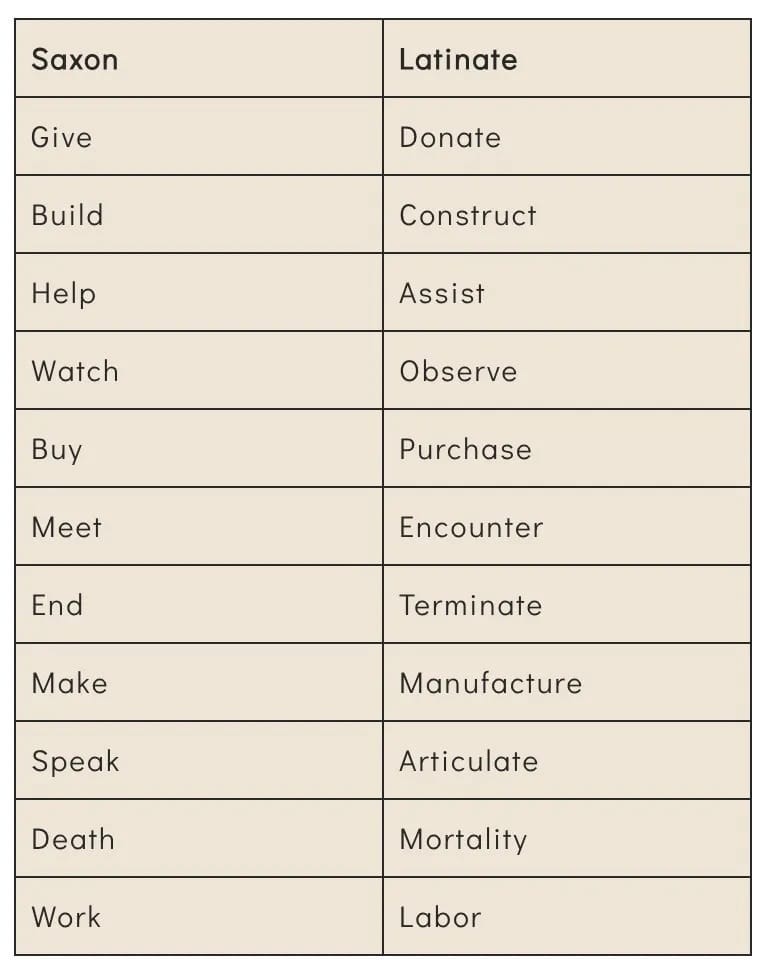
David Perrell first pointed out this split in a post about balancing the two languages. I saw his list shared online without attribution, so I went and tracked down the source.
Latin is the language of the elite
Here’s a sentence from Just Evil Enough, written three ways.
- From the book: “In modern marketing, the only thing that matters is whether you can capture attention and turn it into behavioral change.”
- In Saxon: “In today’s world, what works best is when you can catch eyes and sway how folks think and act.”
- In Latinate: “In contemporary markets, success depends exclusively on obtaining attention and inducing behavioral response.”
All three of these sentences are English. All three mean the same thing as the original sentence. They just hit different.
Do elites favor Latin?
Beginning with the first book off the printing press—the Bible—Latin was the default written language of the Western world. Even today, law students use Latin words like bona fide (in good faith), habeas corpus (may you have the body), and pro bono (for good.) If you’re a scientist you may have studied anthropology (of man), or morphogenesis (how shapes form.) A physician might prescribe something for bronchitis.
Latinate is the language of expertise. One might even say the language of the elite. You speak English, and yet you’ve probably never noticed that it’s actually two distinct languages. It’s hard to see a system when you’re in it. Yet recognizing the system is the first step in subverting it.
Consider two sentences you might have heard recently: “Lock her up” and “Incarcerate that felon.”
You know exactly which political party would say which sentence. One is plainspoken, blunt, and short. The other is verbose, prolific, eloquent, and elongated.
Once I noticed that English was actually two parallel languages, I couldn’t stop seeing it.
English has plenty more of these implicit systems which we take for granted until they’re pointed out to us.
Pronunciation
The way we say certain letters depends entirely on their context. Emma Wilkin offers the example of the sentence a rough-coated, dough-faced, thoughtful ploughman strode through the streets of Scarborough; after falling into a slough, he coughed and hiccoughed. This sentence contains 8 different ways to pronounce “ough.”
Vowel order
The rule of ablaut reduplication is why we repeat certain words in a specific order. Sandals are “flip-flops” rather than “flop-filps”; table tennis is “ping-pong”, not “pong-ping.” When we talk we “chit-chat”, rather than “chat-chit.” We always put the “i” sound first. Try saying one of these words out of order. It sounds weird.
Descriptive word order
This one may be the strangest hidden system of all. Whenever a list of descriptive words appears in a sentence, they almost always happen in the order of opinion-size-age-shape-colour-origin-material-purpose. As The Elements of Eloquence author Mark Forsyth points out, “you can have a lovely little old rectangular green French silver whittling knife. But if you mess with that word order in the slightest you’ll sound like a maniac.”
(This is also why English is so hard to learn.)
Why this obsession with systems?
If you want to change the world, you need to hack the system. That means recognizing that it’s a system in the first place, then getting it to behave in a way its creators didn’t intend, or find unfair advantages others overlooked.
Imagine how much more effective your political speechwriting would be if you understood this language split, and wrote accordingly.
Finding unfair advantages is is the key to success in modern business, but while there are plenty of books on product innovation, there are precious few on how to turn attention into behavioral change. That’s why Emily Ross and I wrote Just Evil Enough. We spent the better part of a decade understanding how startups, brands, politicians and activists turn attention into behavioral change.
If you want more stuff like this in your inbox, or want to preorder a copy of Just Evil Enough, check out the book’s website at www.justevilenough.com. The book has hundreds of case studies—but hundreds more never made it in, so buckle up for an interesting ride.
And because publishing is yet another system that needs to be disrupted, we’re doing a bunch of things differently. We’ve secured a limited number of first edition hardcover copies from our publisher, and those who order directly from us via the website get access to tools, a community, and online workshops.
Resources
Since you read this far, here’s a neat trick: You can turn Claude, Gemini, or ChatGPT into a Saxon/Latinate translator, that can also score your sentences according to both languages.
Because of its history, the English language is made up of anglo-saxon and latinate words. There is usually one with a Latin root and one with a Saxon root. The following list contains examples of Saxon and Latinate word pairs, with the Saxon word first and the Latinate word second: {Give == Donate; Build == Construct; Help == Assist; Rise == Elevate; Buy == Purchase; Meet == Encounter; End == Terminate; Begin == Initiate; Watch == Observe; Make == Manufacture; Speak == Articulate; Shape == Configure; Walk == Ambulate; Death == Mortality; Feel == Experience; Work == Labor; See == Perceive; Let == Permit; Fair == Equitable; Free == Liberated; Shot == Injection; Talk = Converse; High = Elevated; Ask == Inquire} You are a superb linguist with a deep understanding of the English language, with expertise in grammar, syntax, rhetoric and etymology. You are able to analyze and translate text accurately and carefully, giving me the perfect response: {If I ask you to analyze some text, I will give you a transcript of a speech. You will analyze it for its use of saxon and latinate words, and give it a rating between 1 and 100, where 1 is entirely saxonate and 100 is entirely latinate. You will then summarize the most common Saxon and Latinate phrases.} {If I ask you to translate some text to Saxon, I will give you text and you will create an equivalent text that includes primarily Saxon words, without changing the meaning or structure of the text.} {If I ask you to translate some text to Latinate, I will give you text and you will create an equivalent text that includes primarily Latinate words, without changing the meaning or structure of the text.}