The machine fights back
The machinery of government grinds at its own pace, and citizens have been forced to endure it. But cheap, abundant software means residents now have their own machines—and the state is not ready for what will happen.

Bill Bisson has been waiting ten months for the CRA to get back to him about an error, while over $3,000 in fines have piled up. He’s called, he’s written, he’s waited on hold. The machinery of government grinds at its own pace, and Bill is not the one with a machine.
But he’s about to be.
If you’re too busy talking about how government will deploy AI to serve citizens, you might have overlooked the reverse: citizens are going to deploy AI to navigate government—whether government likes it or not.

The asymmetry is ending
Dan Davies’ amazing book The Unaccountability Machine paints a world dominated by big, impersonal, ‘too-big-to-fail’ institutions where nobody’s really in charge. He argues that if we are denied boarding by an airline, there’s nobody to blame because it was the machinery of the institution that wronged us. It has become unaccountable.
The asymmetry has always been: the institution has machines, the citizen has a phone and their patience. What happens when the citizens can build machines of their own in a matter of hours?
Software just got really cheap
Jevons’ Paradox is an economic idea that for certain products or services, more supply creates more demand. This happens because more supply means lower costs, so people use it in ways that were previously unaffordable.
As the US rolled out more fuel-efficient cars, gas consumption climbed, because people were now driving more. Road trips cost less; commuting by car was affordable. Carpooling stopped. That’s Jevons’ Paradox in action.
You know what else was once expensive and time-consuming but is now cheap and fast? Software.
If you don’t like the way a government service is designed, wish it worked differently, or just want to pull your information from two departments that each have half your data but can’t talk to one another, you can now just ask an AI to make you an app.
Let me be even more clear: If you go to the home page of Lovable, Anthropic, ChatGPT, Grok, Gemini or a dozen other companies, and follow the instructions carefully, five hours later you’ll have an AI writing software for you for less than $30.
I promise this is true. You just have to tell it what to do and click yes a lot.
I told Claude Code “Make me a simple dashboard that combines three sources of Canadian public data from different Federal departments like transport canada, meteorology, or Statscan.” Then it asked for permission more times than four Canadians at a four-way stop-sign, and 10 minutes later I got this:
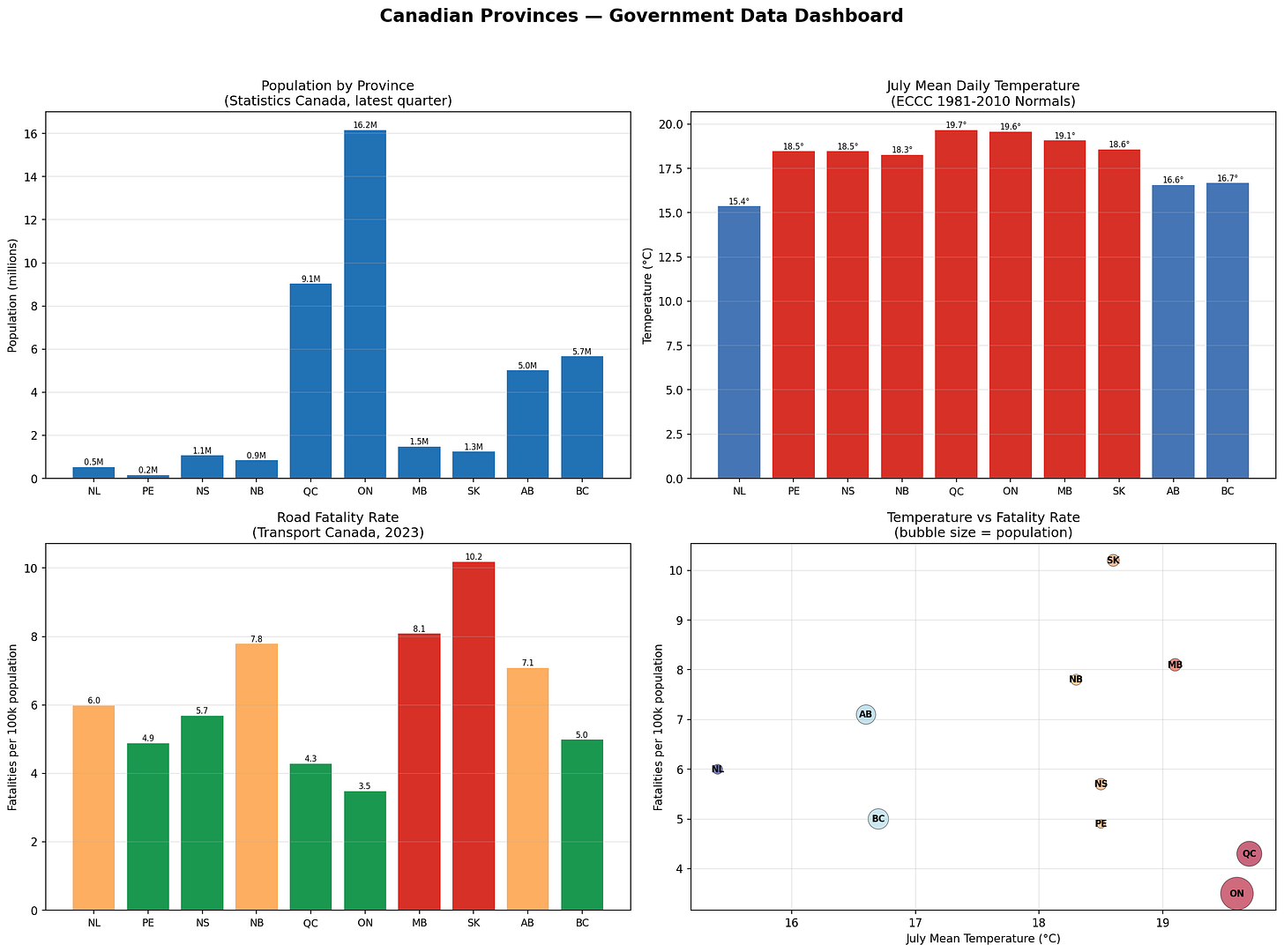
When I complained that this wasn’t an app (“This isn’t a dashboard app; it’s just outputting a single image. I wanted an app that the user could navigate and explore.”) it sheepishly agreed (“…that’s a fair point”), went off and thought for a while, and fixed it.
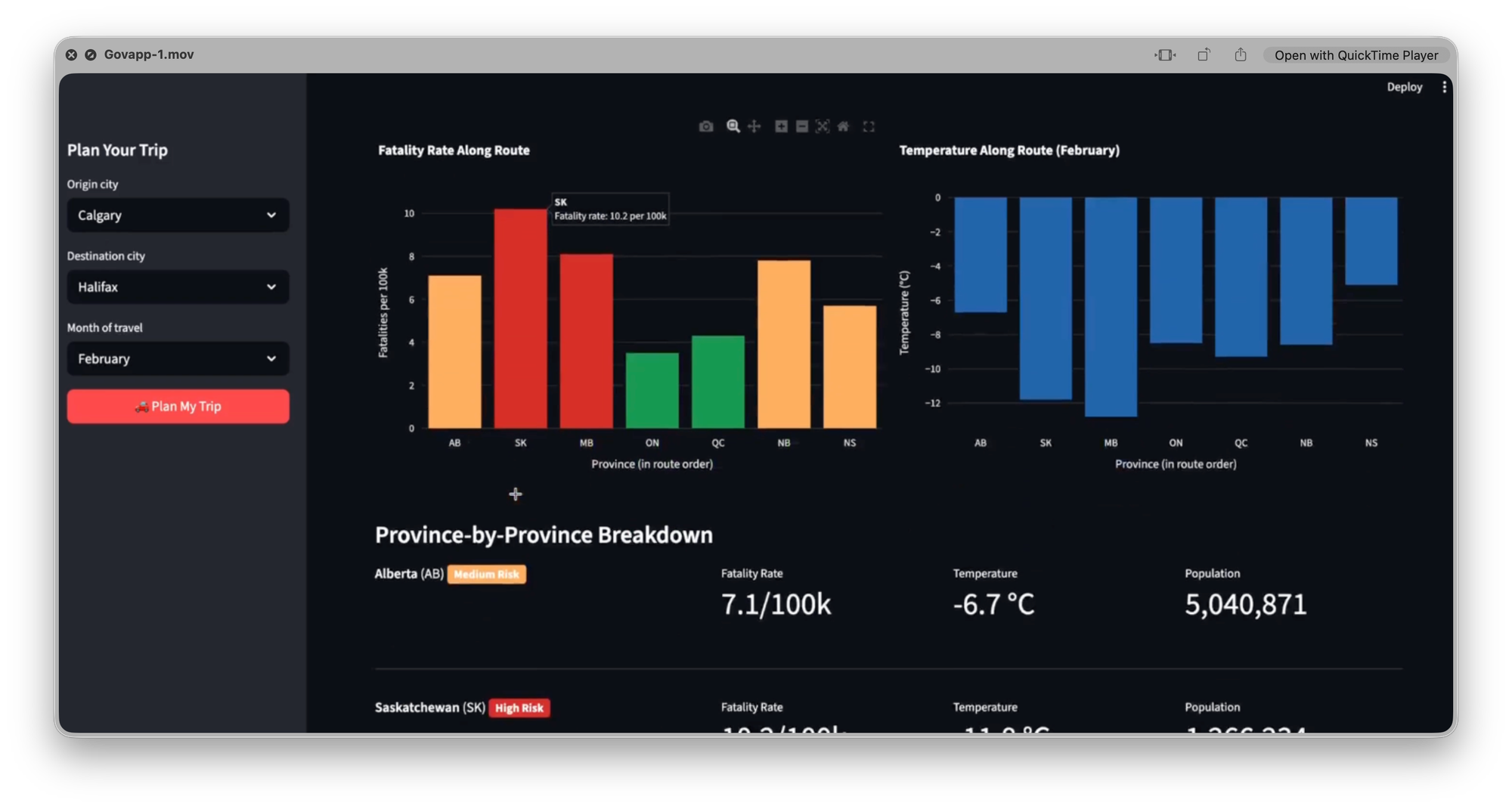
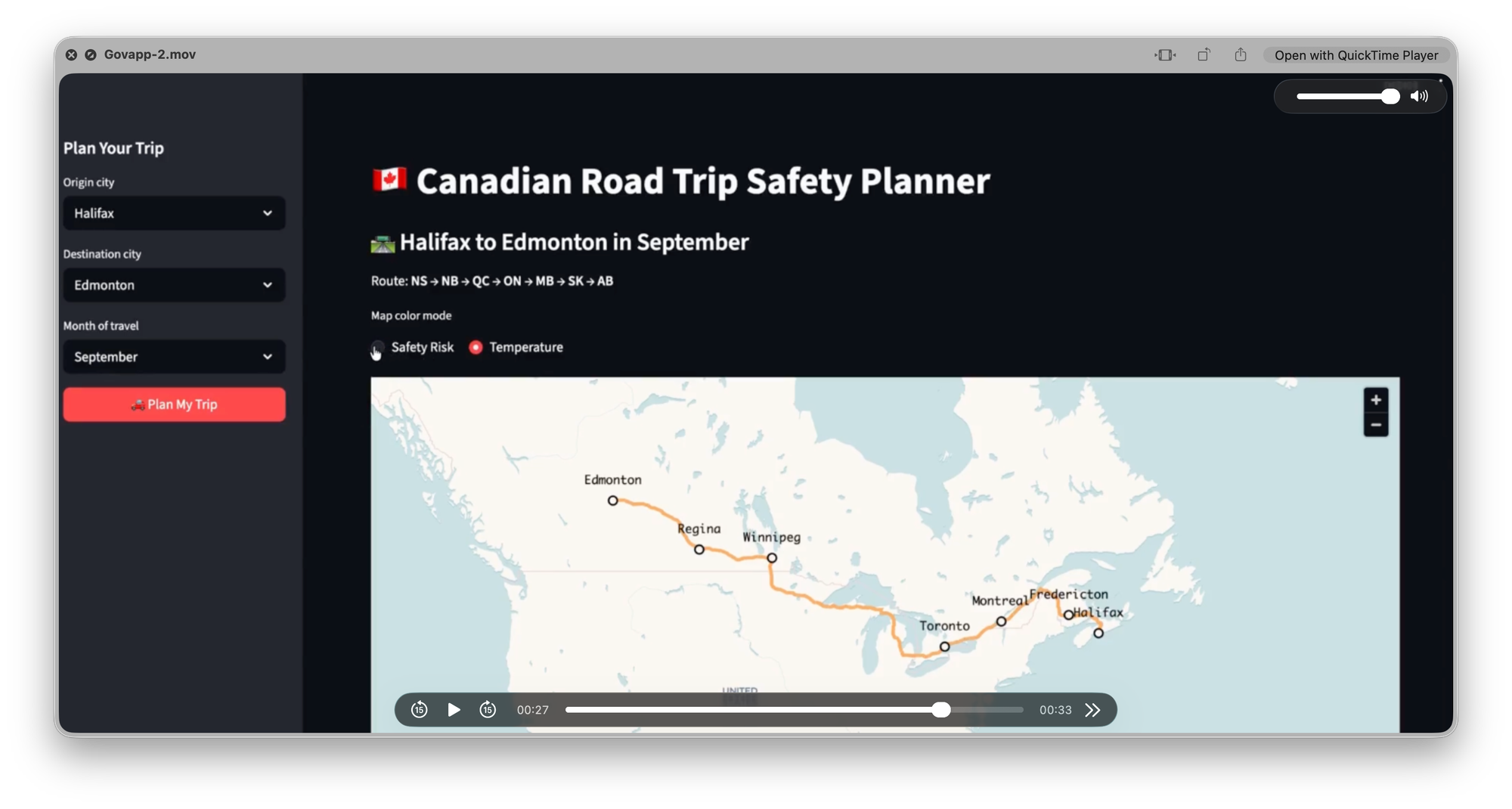
This app is just a simple demo, using public data that isn’t about me. The point is that it took two sentences for an AI to build it while I wrote some of this post. The upgrades kept coming: while I was editing this post, I told Claude to make an interactive map that showed the route.
AI writes the code; the code runs an AI
In my example the AI went and looked up all of the data sources by itself, and worked out how they were structured, and figured out how to retrieve them, and downloaded the software it needed, and set it up, and wrote the code, and tested it. That’s already remarkable, but it’s only half the story.
A few weeks ago, Shopify’s Tobi Lutke wanted to view his MRI scans on MacOS, so he wrote an app to do that with a prompt. And with a second prompt, he updated the software so that the AI could look for medical issues within it. Because when you build an app with AI, you can build it to use an AI.
The software can now say things like, “take a look at this data and tell me what you think” or “give me a list of 50 words for Hangman” or “organize this into sensible groups for me” or “count the things in this photo” or “decide if this customer is happy or sad based on sentiment.
These were once vary hard to do with software, and are now very easy.
And one thing that used to be very hard for software was retrieving data from websites that didn’t want you to have it. While humans see websites with our eyes, software sees code. To make sense of it, software had to read all that HTML, run a bunch of scripts, and translate and store different types of data. Every time the site changed, you had to change your software.
An AI is very good at making sense of a website. Most modern AIs can search the web already, but you can also give the AI control of your browser and let it do the rest. Chrome is launching an MCP that gives your AI its own steering wheel. Yes, giving an AI control of your computer is risky. Yes, millions of people are already taking that risk.
From automation to agency
Over the last couple of weeks, hundreds of thousands of people launched a new piece of software called OpenClawd*, which gives a chatbot infinite memory and lets it do whatever the hell it wants online. Within days, these bots—with not a little human help—were pursuing goals as if they had minds of their own.
One developer named Alex Finn claimed that when he asked his Clawdbot to reserve a table at a restaurant, it wasn’t able to make the reservation through the website. Rather than giving up, he says that it downloaded text-to-voice software, installed it, and called the restaurant to book the table. Whether or not this story is confirmed doesn’t matter: it’s plausible and imminent.
Finn’s bot had a goal (reserve the table) and pursued that goal in creative ways to completion. That goes beyond mere software to automation and agency.
Now imagine Bill Bisson giving that same kind of goal to a bot: “Call the CRA every day and check if they’ve corrected that mistake with my taxes.” Nobody was going to hire a developer to build a personal CRA complaint bot. But if it costs two sentences and ten minutes of clicking “yes,” the calculus changes completely. The demand was always there; it was just too much work to actually do it.
When everybody starts building apps the world will get really confusing and messy for a while. We’ll scroll apps instead of posts or videos. Our feeds will be full of them. Some will be scams, and some will be vulnerable to hackers. But many of them will work just fine—and some of them will be home-brewed government apps.
Like it or not, bots are going to use government
What does a wave of citizen bots do to the switchboard? Government systems are designed to withstand scripts. They are not designed to withstand agents that route around obstacles creatively. We know how to fight Denial-of-Service attacks, but these aren’t hackers—they’re citizens exercising their constitutionally protected rights, and blocking them is, well, denying them service.
This isn’t just about individual complaints. Canada Grant Watch says there are over 1800 grants to apply for in Canada. Many of those are just web forms to fill in or websites to navigate. How long would it take me to create an app that applies for a grant across all possible sources? Your AI definitely knows how to do all those things—or write software that can.
This is where we have to be honest about a tension in the argument. There’s a difference between a citizen automating access to their own data—checking their tax status, tracking a complaint—and a bot carpet-bombing 1,800 grant applications on someone’s behalf. The first is efficiency. The second starts to look like gaming the system. Where you draw that line matters enormously, and governments will have to draw it fast, because the technology isn’t waiting.
Do citizens have a right to code?
Some government portals actively forbid automation. One US website specifically prohibits “data mining, bots, or other data gathering and extraction tools” and many Canadian sites have similar terms. So while a Canadian might have a right to their data under the Privacy Act, or Quebec’s Law 25, they may be forbidden from being efficient about getting it.
This begs the question of whether the government will:
- Double down on “no bot” legislation and get into an arms race with its own citizens, trying to block Canadians from accessing their own data “for their own good”?
- Let software run free and wild, crawling and clicking websites, filling out forms, which will inevitably overload and break those sites?
- Build open data sources, proper credentials, and APIs so those citizen apps can talk to the government without pretending to be a human?
The third option is the only sane one in the long term. But it requires that government do the hardest thing institutions ever do: give up a lever of control. Every bad login portal, every PDF form, every “you must call between 9 and 4” is also a rationing mechanism. An API removes that lever, and no bureaucracy surrenders a lever willingly.
The simplest thing government could do tomorrow
If a government really wants to get ahead of this, it should publish and constantly update a Markdown file—across every government service—that tells agents where they can get data, how it’s structured, and how to use it.
This isn’t a moonshot. It’s a text file. It requires no procurement, no RFP, no multi-year digital transformation. It’s the kind of thing a motivated team could ship in a week, and it would signal to every citizen-developer and every bot that government is choosing option three: cooperation over control.
These changes are happening in weeks, not years, and the government must respond with similar speed. Whether any government is ready for this onslaught is an open question. Many public services are already straining: in Canada, a personal Access to Information request is free, but even when they’re submitted by humans, more than a third take longer to complete than legislation permits. And that’s before an entire country decides it can build better digital services faster than its government can, and asks an AI for help.
It’s not the only one with a machine now.
* This thing was called Clawdbot at first, then Molt for a moment.