Office hours
I'm running an online office hours to talk about what I've been learning about AI, and answer questions. It's free; join if this is your thing.
Most of the time I feel like an impostor.
I spend a lot of time talking about technology: how it's changing society; how government might use it; what startups are building with it; the ways it's changing organizations and our brains. But I’m still a spectator: I don’t really make things any more. Before I was a product manager, I built BBSes and websites, but I lost the thread.
AI picked it up for me. I’ve spent the last three months building things again. Not just my own things; AI tools have let me reach inside others’ products, exploring and poking and breaking and understanding them. I’m trying to build the systems that will run my life before others build them for me. And I have ideas. SO MANY IDEAS.
I still don’t know what to think about it all. I’m scared by how addictive it is (Ramon is right.) I don’t know if it’s just making me incredibly productive at things that don’t matter. And I’m worried that I’m abdicating planning because it's so damned easy.
But the most honest thing I can say is: if you’re not actively building with these tools right now, you are falling behind in ways that will be very hard to recover from. The gap between “this is interesting” and “this changes everything about my job” has collapsed from years to weeks.
Almost daily, someone asks me to grab a coffee or jump on a Hangout and compare notes on what we’re learning. Each conversation is a chance to see this quickly-changing world through someone else’s eyes. But the landscape is shifting so fast that by the time that coffee is empty, the next thing has already arrived.
So I’m starting something new.
What this is
I’m going to run an Office Hours online to share two or three things I’ve learned about AI—things that surprised me, unsettled me, or changed the way I think about a problem. Then I’ll open it up for questions and we’ll figure things out together.
Here are three things I’m thinking about a lot right now:
- The asymmetry is ending. Citizens are about to build their own AI agents to fight bureaucracy, and government is not ready. I wrote about this in The Machine Fights Back—how Canadian waiting ten months for the CRA to fix an error can now build a bot to call them every single day. When software was expensive, institutions held all the leverage. That's over.
- Don't sell what you can make—make what you can sell. If AI can build almost any software in an afternoon, then software isn’t the product anymore. What competitive moats are left? Every business is a startup again, whether it wants to be or not. And much of the Venture Capital industry is like Wile E. Coyote, desperately hoping it hasn’t run off a cliff.

Vocabulary is now a coding skill. Prose is code. The person who knows what “dependency injection” or “race condition” or “refactor” means gets a better result from an AI than the person who spends three paragraphs describing the same concept. Fluency in technical terminology is becoming a competitive advantage that has nothing to do with writing code. So what’s the new programming language? (I dug into this in The Vocabulary of Agents.)
Why me, why now?
I’ve been lucky enough to spend two decades at the intersection of technology and strategy, with a front row seat for the consumer Internet, Web 2.0, cloud computing, big data, and AI. I’ve seen a lot of technology shifts. This one is different—not because the technology is more impressive (though it is) but because of the speed.
I don’t have all the answers. I might have good questions, a decent framework for thinking about them, and a willingness to be wrong in public. That seems like enough to start a conversation.
Come talk about the future
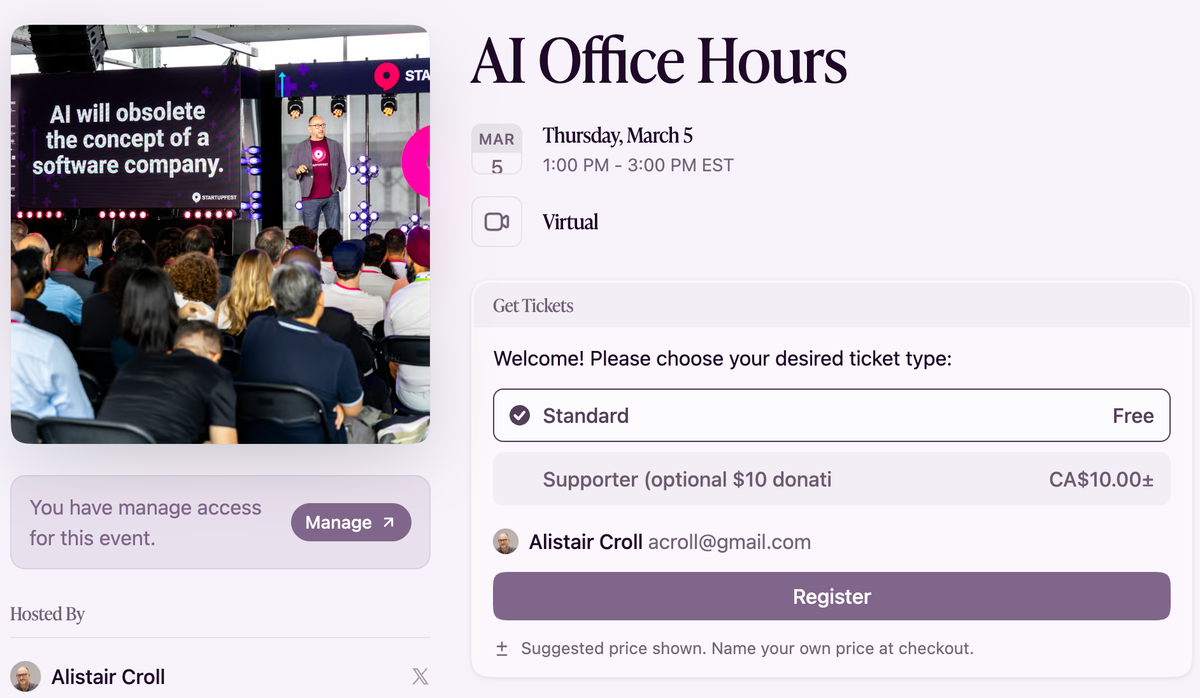
The first Office Hours is on Thursday, March 5, 2026 from 1-3 PM EST. You can register on Lu.ma
It‘s free. Show up, bring questions, tell me where I‘m wrong. If it‘s useful and fun, we‘ll keep doing it every couple of weeks.
See you there.
P.S. If you find it useful, you can kick in $10 when you register.