We didn’t lay a hand on him
In the book 1984 , George Orwell describes Room 101 , the place where your captors expose you to your worst fears and crush your will, breaking you forever. It’s one of the most bleak, troubling, haunting things I’ve ever read. “One, a woman, was…
In the book 1984, George Orwell describes Room 101, the place where your captors expose you to your worst fears and crush your will, breaking you forever. It’s one of the most bleak, troubling, haunting things I’ve ever read.
“One, a woman, was consigned to ‘Room 101’, and, Winston noticed, seemed to shrivel and turn a different colour when she heard the words.”
I was an early backer of the Oculus Rift. Even in its nascent, prototype form, it offers an amazing glimpse into immersion. It’s fast enough to convince you you’re looking at a real scene. It induces vertigo. When combined with decent sound through headphones, the illusion is almost complete. The new version of the Rift was released at CES recently. It’s a significant upgrade in many ways, but most importantly, it overcomes one of the few real limitations of the original device. Ars Technica said that
... it’s hard to overstate just how much this changes the Rift virtual reality experience. Now, if you see something interesting, you can actually lean in to zoom closer to it.
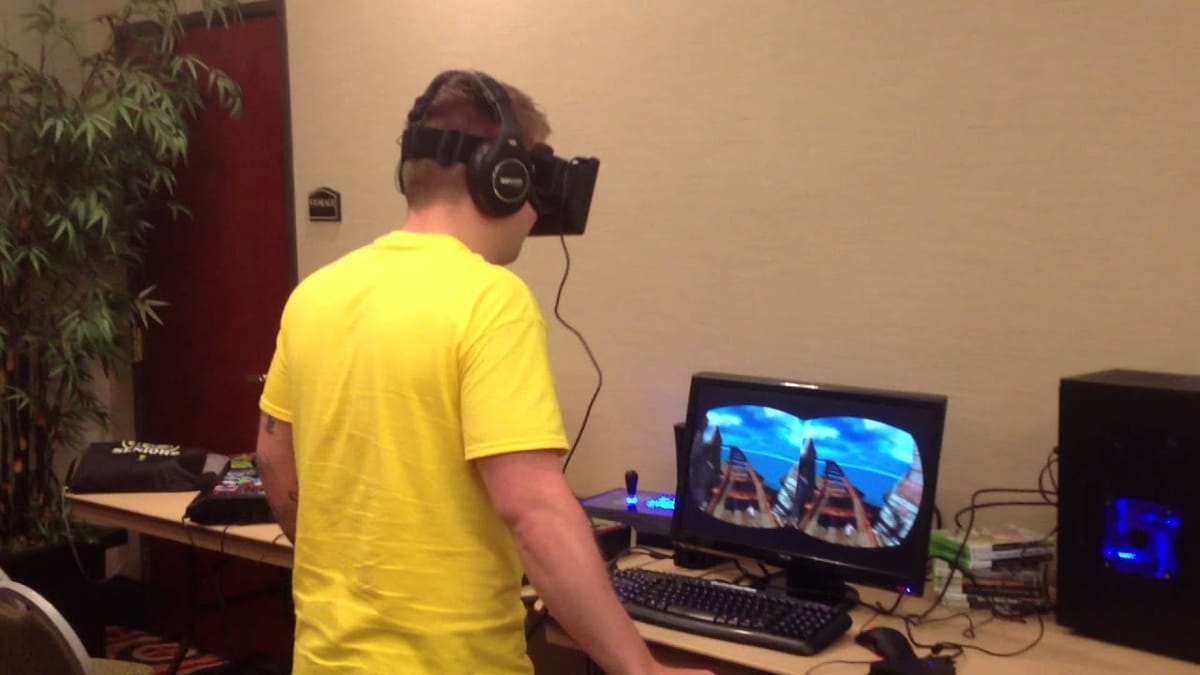
Here’s a guy who’s afraid of roller coasters trying out the original version.
Now consider the number of tools we have to measure your mental response to stimuli. We can show you a picture of something, and examine your brain’s response in a number of ways, from basic galvanic response, heart rate, and pupil dilation to reading your brainwaves to full-on MRI. From there, it’s a short stretch of the imagination to create a virtual hell, filled with the most horrible stimuli possible, targeted at the prisoner in question. But unlike the rollercoaster-phobic victim above, there would be no way to take off the goggles, or the headphones. There would be no escape.
This isn’t science fiction. It’s all well-understood technology. I’m pretty sure most citizens would consider a workflow like the one below far less cruel than waterboarding
: Closer to home, I can easily imagine someone testifying, after such a program is revealed, “no, senator. We simply measured his vital signs and gave him a series of audiovisual stimuli. In fact, we never laid a hand on him
.” The Geneva Convention protects against “severe mental and physical suffering.” But that mental part is awfully subjective. I suspect it needs some updating when physical and virtual worlds are indistinguishable, and when we can so easily make personal hells to achieve our goals.