Unemployment is not a bad word
Grant one thing: self-driving cars are coming. Now follow the consequences through trucking, gas stations, insurance, and urban planning. Unemployment isn't a bad word — if we're willing to rethink what work means.
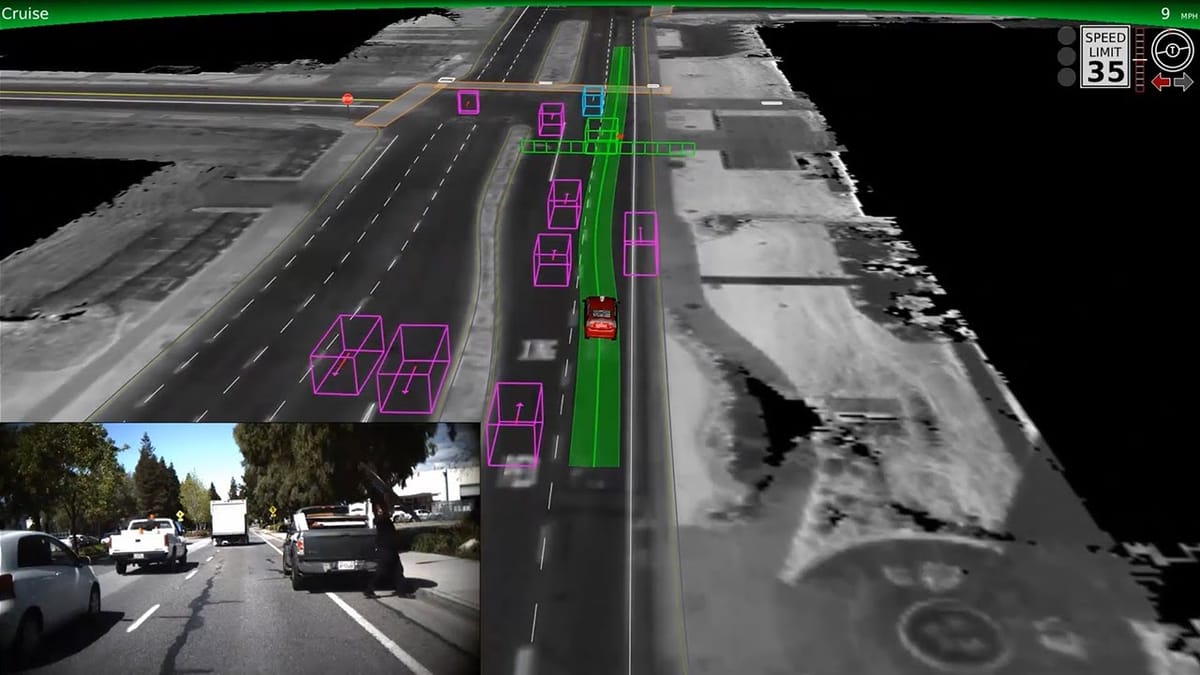
A few weeks ago, I met with a minister for economic development. I wanted to convince him that the world tomorrow would not be the world yesterday, only more so. I needed an example pulled from science fiction, but also credible. The stuff of both dreams and headlines. I settled on the self-driving car. Google’s self-driving vehicles are a wonder. They’ve already driven millions of highway miles, using a clever mix of artificial intelligence and collective learning. Here’s an example of just how sophisticated they are:
“So,” I said, “grant me this one thing: that self-driving cars will be a reality, soon. That they are safer, easier to insure, make humans more productive, and so on.” I could have added that once your co-worker gets an extra hour of work done on the way into work, you’ll pretty quickly conclude that you need one too, but he was already convinced. Even the New York Times’ John Markoff called the ride “boring,” which is, if you think about it, the only way it should be.
What self-driving cars do kill
At this point, we discussed all of the other things that would change when these cars became a reality in his country. In a piece for the Atlantic, Alexis Madrigal said the technology will “cut traffic accidents, expand the carrying capacity of the nation’s road infrastructure, and free up commuters to stare at their phones.” But that’s just scratching the surface. We quickly came up with a list of things that might change, which I’ve gone into a bit more detail below.
Truck driver jobs
Long-haul trucking is a big industry. According to the American Trucking Association, in 2013 trucks moved 69.1% of all domestic freight tonnage and collected 81.2% of all freight revenue. The industry employs over 7 million people—two percent of the US population.
Truck stops
The National Association of Truck Stop Owners represents 1,230 travel plazas and truck stops, owned by over 200 companies. Other than refueling and repair services, we don’t need them when the drivers are robots. Sure, there will be roadside attractions for passengers, but they’ll be very different from today’s vast parking lots sprawling with power, prostitutes, and pork rinds. And they won’t need related goods and services such as detachable cooling, rented TV hookups, auxiliary power units, and so on.
Taxis
In New York, where drivers must buy a medallion from the city to allow them to drive the iconic yellow cabs, the price of a medallion has risen as high as $1.25M at auction. Many drivers aspire to own a medallion, and put everything they have into acquiring one as a legacy for their families. It’s a lifelong investment. Today, there are 13,605 licenses, and 51,398 licensed drivers. Simple math says that’s $17B in medallion speculation. But will we need all those cabs when a car can pick us up? And if we do, will it have a driver in it? It makes no sense to have a driver in the vehicle when it’s a taxi. Self-driving taxis make far more sense. But that’s just in the short term; longer-term, taxi fleets will be replaced by pooled car-sharing services anyway.
Police revenues
Every year, police forces generate big money from speeding tickets. Amazingly, it adds up to around $300,000 per officer per year—$6.2 Billion in all—which is going to evaporate. How law enforcement will fill those coffers is a mystery, but when local government budgets fall short, speed traps are called in to make up the difference, so it’ll likely put a big strain on the money that cities have available to spend.
Lawyer revenues
Self-driving cars haven’t been ticketed yet. And when they do, there’s legal debate about whether the ticket goes to the company or the driver—ditto liability. But one thing’s for sure: there will be an abundance of data available about what happened. That means less arguing about who was right or wrong, and more reviewing simulations to prevent accidents. But say goodbye to drunk driving, parking, speeding, and driving claims.
Wasted time
The average American works 7.65 hours a day. They also spend about 24.3 minutes driving there. That means working in a car adds 10% to your workday. Put another way, that’s more time than the average US 2-week vacation. Now consider what you’ll do with that time. Catch up on Game of Thrones? Doze? Or maybe worry that your co-workers are more competitive than you are? Who knows, perhaps the commute time will let us arrive at and leave from the office in a more staggered way, easing pressure on already-taxed road infrastructure. Certainly, central scheduling among cars can eliminate the stop-and-start patterns that humans create, making commute times drop.
And when your co-workers start getting more work done than you, that self-driving car will look pretty good.
Service centers
Gas stations and service centers as we know them will change significantly. It’ll be easier to service more cars, centrally, because they’ll be able to drive themselves in when their analytical systems detect a problem. Just as General Electric uses data to figure out when an airplane part needs replacing—based in part on the condition of other planes that have flown the same route—so we’ll have communal insight into car problems. Those service centers will operate at night, and be more focused on fixing the problem than diagnosing it. Whatever the case, your corner gas station won’t be doing a lot of repairs. It’ll just be pumping gas (or perhaps the cars will pump their own, which in turn suggests a change in the design of gas stations.)
Public transport
There are 654,300 bus drivers in the US. Bus routes are repetitive, and easily mapped; they’re also better when the bus timing is predictable, since they run on schedules and are often attached to open data initiatives. And they’re subject to economic scrutiny: cities have adopted hybrid transport far more quickly than consumers have, because the financial advantages are overwhelming. So say goodbye to bus drivers, and hello to automation.
Car sales
One of the unintended consequences of digital technology is that it significantly lowers the friction of a system. Car2go realizes this, which is why it floods city streets with cars—then, when you join, there’s one nearby; and you can park it anywhere. But there’s still a headache involved, because you actually have to go find a car.
By contrast, pooling your self-driving car with others trivializes many of the problems that carpooling services face today. You always know where the car is, and what condition it’s in. It can take itself for a refill, or a service call, or even a cleaning. And you can simply summon a car with a mobile app. As for parking, maybe you get a credit for letting the car park in your driveway until the next time it’s needed by someone.
There’s already a huge surplus of new cars in the world today. It’s a dirty secret, but it’s increasingly hard to hide. Car companies own rental companies so they can pump surplus production into rental fleets (although the recent, viral tale of car companies parking vehicles outside to rust is patently false
.) By introducing liquidity into the mix, self-driving cars make car sharing services vastly better than they are today. Tiered services mean you could sign up for the deluxe model, or the truck, or the sports car.
Car rentals
Once seamless car sharing exists, why not make it global? Car rental companies make money from the idleness of your current vehicle: when I’m in San Francisco, I’m paying for a car partly because my car in Montreal is idle. If i were able to swap with someone, the rental agency wouldn’t need to exist. That industry is $24.5B a year, and keeps nearly 2 million cars on the road.
Valet parking and parking garages
Need to get out quickly? Your car is your valet, dropping you off before parking somewhere nearby. Or just idling, for that matter. Even parking garages can be more efficient, and might even coordinate with cars to maximize space. Of course, the very idea of a parking garage is based on the fact that cars sit idle 95% of the time. When self-driving cars introduce fluidity into the car ownership market, those lots—and the city coffers they line—will be far less empty, because shared cars are driven more.
Here comes unemployment
The Economist warns that automation of all kinds is coming to the world’s workforces. Add up all the jobs and revenue sources that fall out of the workforce when this one, relatively simple, example arrives. It’s not even science fiction at this point—it’s just science. Yesterday, I was explaining this example to another local politician. “You’re judged on unemployment numbers,” I reminded him. “What happens when unemployment goes up? Permanently?”
Progress means changing how we keep score
The Economist’s warning about capital concentration and the rise of automation that means more work but fewer jobs ends with an important observation:
Innovation has brought great benefits to humanity. Nobody in their right mind would want to return to the world of handloom weavers. But the benefits of technological progress are unevenly distributed, especially in the early stages of each new wave, and it is up to governments to spread them. In the 19th century it took the threat of revolution to bring about progressive reforms. Today’s governments would do well to start making the changes needed before their people get angry.
Many of the industries I’ve described above—bus drivers, truckers, taxicab owners, police forces—are either unionized, or well-connected to lobbyists and policy-makers. When digital technologies make an industry more efficient, as they have for AirBnB’s house rental, Uber’s taxi model, and dozens of others, cities are quick to protest. In New York, AirBnB is embroiled in a visible legal battle ; in Paris, Uber drivers had to give taxis a 15-minute head start ( a law which was since overruled ); despite this, Uber cars are being vandalized . Venkatesh Rao calls this Uberreac
tion The pace of innovation and competition is only going to increase. Services like Uber and AirBnB stand on the shoulders of giants—both of them leverage mobile networks, free mapping tools like Google Maps, and payment gateways. Once, a London cabbie needed to pass The Knowledge , a test of their understanding of the city’s Byzantine roadways. Today, an Uber driver only needs a smartphone. These digital foundations make it possible to tear apart markets quickly and mercilessly.
As machines rolled across Industrial England, turning pastoral greens into William Blake’s dark, satanic mills , people rose up. Eventually, we made peace with the machinery, steam replaced muscle in many jobs, and we ended child labor, gained the weekend, and legislated fair labor practices . Similarly, with the rise of robots and automation, we’re going to have decades of disagreement before we reach an agreement.
- It’s not as simple as saying, “let the self-driving cars win”—that’s not fair to the taxi medallion owner whose life savings have been dashed by software. It’s a matter of wide-ranging policy and compromise. Do we have a moral obligation to create a social safety net for those who banked on a tomorrow that was like today, only more so?
- Lifelong re-education is essential, since the span of jobs and the skills we’ll need increase. Once, our employers outlived us; today, we jump from company to company, and have a mercenary blend of contract and full-time employment. It’s fitting that Sebastian Thrun, the creator of the self-driving car, has since launched Udacity, a training platform that uses data to improve how people learn.
Shouldn’t we be celebrating technical advances that make more people have free time? This is a real challenge for politicians. We keep score based on employment, because it is a proxy metric for productivity. But we should be celebrating free time, that which lets us explore, learn, and create. We should be happy we’ve created more time for the species, rather than bemoaning it as laziness. I’ve only touched on a few industries directly impacted by the self-driving car. But consider some adjacent questions:
- How would a society cope with a three- or four-day work-week?
- Would we split the remaining jobs among several people—and how would they communicate effectively?
- How would child care change?
- Will people move back to the suburbs now that a car ride isn’t an interruption, but instead a small oasis of calm?
- What about package delivery and on-demand grocery stores?
These are real, fundamental shifts, and they’re not really that speculative.
The tomorrow fallacy
Companies that assume the future is like the past, only more so, are surprised when it changes. Startups are quick to capitalize on disruption, because they recognize that it’s discontinuities like the rise of the self-driving car that offer chinks in the armor of big firms. To defend against such onslaughts, Intrapreneurs within larger organizations need to embrace these discontinuities, take them to their logical conclusions, and start experimenting. How would a company’s existing business be affected by self-driving vehicles?
Transportation touches every business and every life several times a day. Would we apply makeup, and shave, during our commute? Does highway broadband need to change fundamentally to support videoconferencing in transit? Should universities and countries be revising their estimates of how many educators they need, or of how long and how often someone will stay in school? The list is endless, and smart innovation officers at big companies are trying to figure it out.
Unfortunately, Intrapreneurs aren’t always tasked with progress. Often, their job is to innovate to stand still—trying to slow down market changes to milk the cash cow. But we’ll get into that in another post.
Afterthought: car design
The 1961 Pontiac Flamingo had a rotating passenger seat. Seems like an idea that was a bit before its time; maybe today it also needs power outlets. Like this? Want more? Some of Tilt the Windmill might turn into a book, or a podcast, or something else. I don’t know yet, but I’m busy finding out. If you want to sign up for updates, custom content, and ultimately, or whatever media comes out of this project, you can do so below. I won’t spam you and I won’t share your information.
Sign up
* indicates requiredEmail Address *First NameLast Name