On chat as interface
There’s been a lot of talk lately about chat as an interface . It’s fueled by the rapid adoption of Slack, and announcements that other companies, from Wechat to Facebook to Kik, are rolling out bots and opening APIs to let algorithms join us in…
There’s been alot of talk latelyaboutchat as an interface. It’s fueled by the rapid adoption of Slack, and announcements that other companies, from Wechat to Facebook to Kik, are rolling out bots andopening APIsto let algorithms join us in chatrooms. Facebook’s building auniversal personal agent dubbed M.
There’s been less chatter about how different chat interfaces are from traditional UI/UX, and what it’ll mean when this matures. Chat has some weird consequences for developer economics, but also for how we build and test user interfaces. Here’s the short list:
- The surface area of the interface is almost untestable.
- The UI is the log file.
- Every user interaction is also a survey.
- Chat is a great interface for the Internet of Things.
The chatroom is the new app store
According to Comscore, the typical American downloads a total of zero new apps a month. We’ve got our apps, and we’re happy with them, and we aren’t looking for new ones. Just as apps clobbered the Web—over 50% of all digital engagement happens in mobile apps—so messaging is likely to replace apps themselves. Consider these four examples:
- Kik bought Blynk, a fashion app.
- You can order a ride in Facebook Messenger.
- The New York Times built a bot in Slack.
- Wechat users can send money to Western Union from chat.
The end of every transaction is the start of a discussion about that transaction.
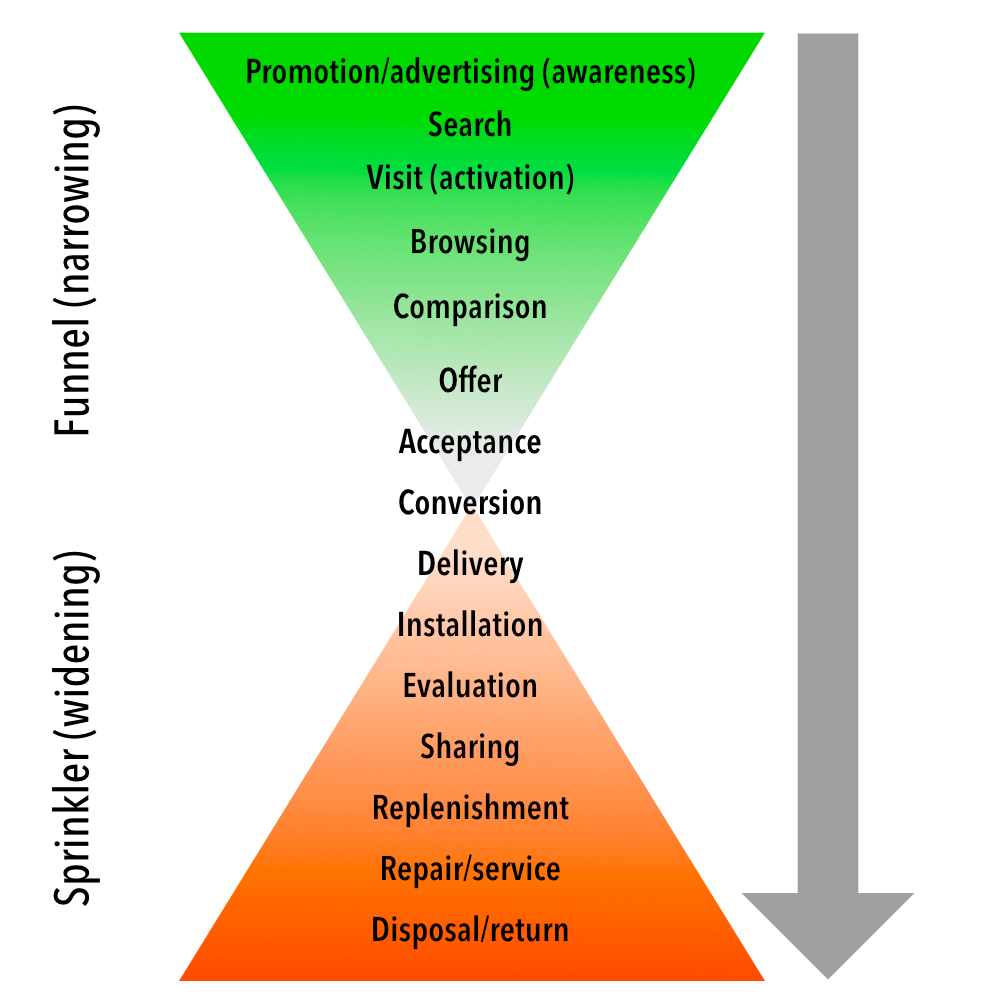
If sales has a funnel, chat has a spout.
Testing is hard
In a point-and-click interface, the designer creates the vocabulary. There’s a finite number of buttons on a screen. But in chat, that’s not true. There are over a million words in the English language alone. The surface area of the chat interface is almost untestable in normal ways.
Debugging is easy
With chat, the UI is the log file. You can reproduce every interaction from every user. You can replay exactly the steps that it took to get to a certain point. You can often learn synonyms, common misinterpretations, and other problems by watching.
Users self-segment
Every user interaction is also a survey. Once you know how to listen, users will tell you what they’re after. Chat participants classify themselves into new niches and segments based on where and how they use chat, and what they ask for.
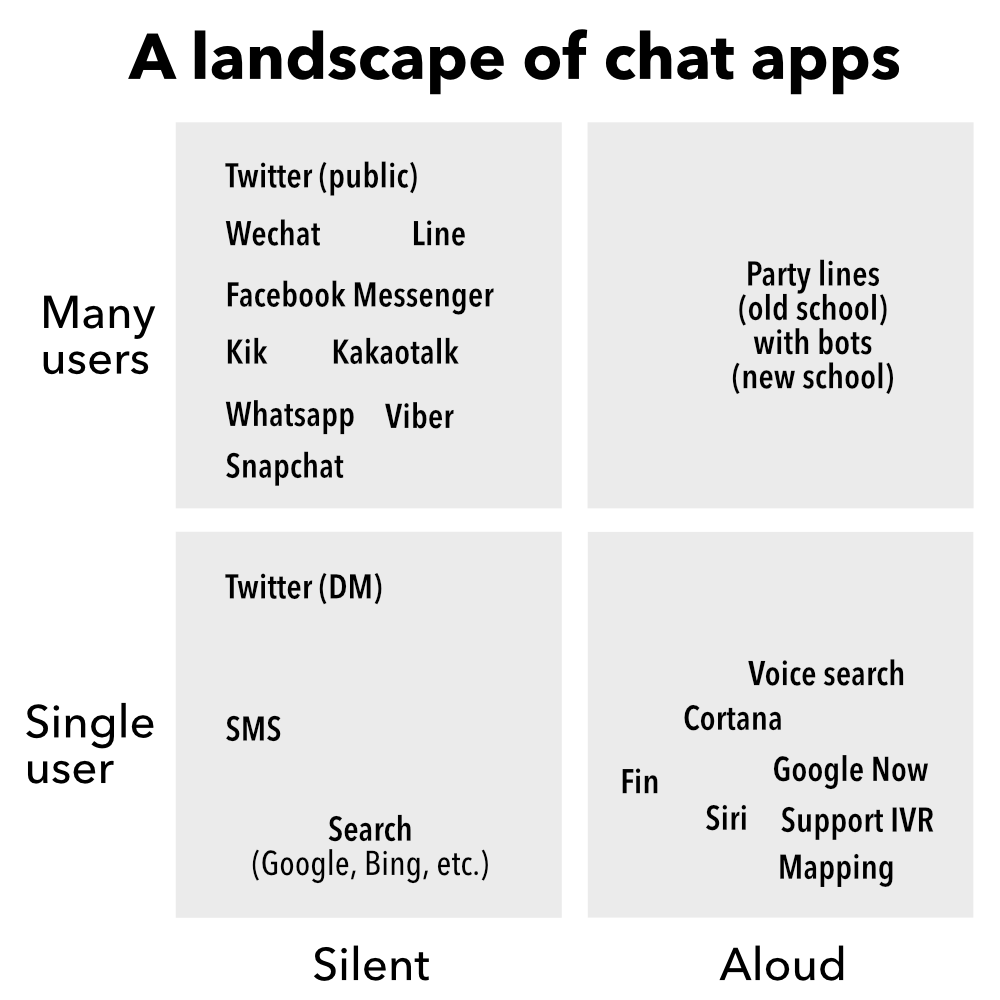
A broad landscape
The long game: Chatting with things
Chat is a great interface for the Internet of Things.I don’t want to talk to my bank; I want to talk to myaccount. I don’t want to talk to my realtor; I want to talk to my apartment. What happens when we can chat with the things in our life?
Everyone gets a KITT.Our car tells us when it needs oil, or when it’s time to change the tires. We ask it where it was last night, and who was driving. A conversation with my car is an insurance record; a maintenance history; and a huge opportunity to sell me things.
It’s also one hell of a sticky interface, likely to make me brand-loyal over a lifetime. When we can chat with our personal agent, or our things, it’ll seem normal. When we can start a thread with friends who are going to a festival, and their bots join in, offering tips, scheduling, and generally helping out, we’ll wonder how we ever did without it.