A simple way to judge digital government
Alistair Croll If you work in the public sector, you’ve probably seen a ton of studies and scorecards rating different governments’ use of digital tools to connect with citizens.
If you work in the public sector, you’ve probably seen a ton of studies and scorecards rating different governments’ use of digital tools to connect with citizens. From paying taxes online, to renewing passports, to transferring property, online portals are the norm for dealing with your city, province, state, or country.
The UN publishes a digital government scorecard that’s so complex, there’s an entire technical appendix explaining how it’s calculated. The formula rolls up over 180 factors: The “E-Participation” metric alone is made up of over 25 sub-measurements including citizen engagement and feedback mechanisms.
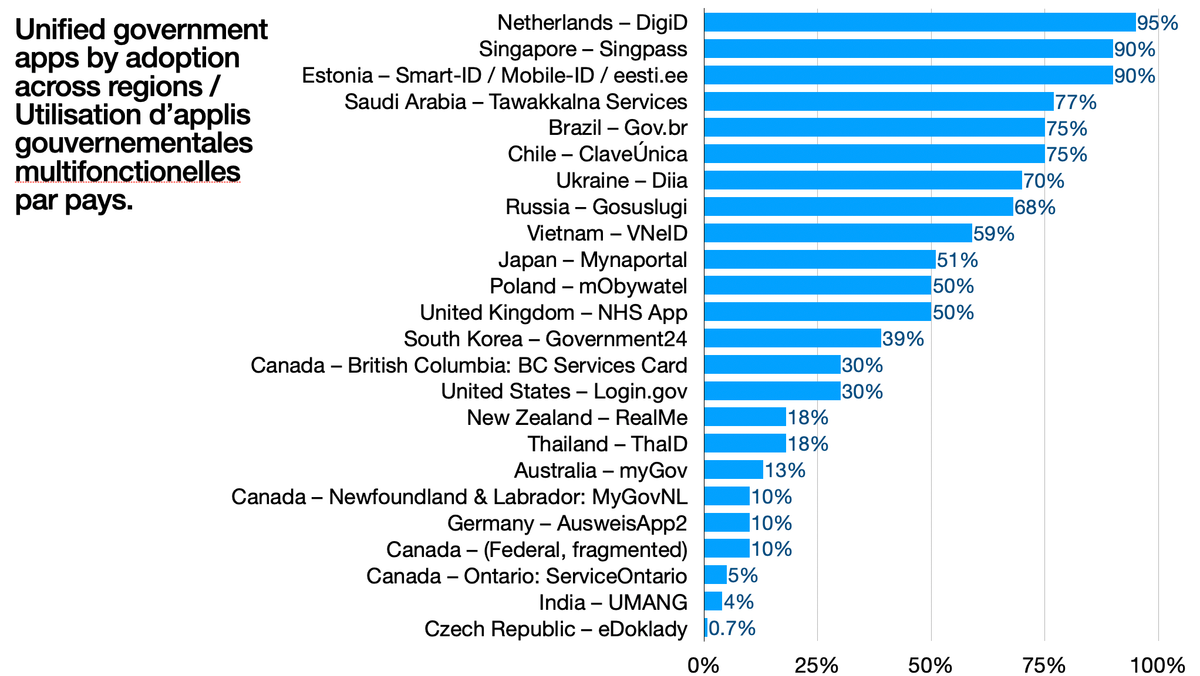
Last month, at our firstFWD50event of 2025, I proposed a much simpler, no-BS metric:How many of your citizens have a government app on their phone?
I don’t mean your local parking app; or that COVID Alert app you haven’t looked at in four years. I mean an app that lets you interact with your government quickly and easily across multiple services. I mean something you install on a new phone along with WhatsApp, Signal, Facebook, Threads, LinkedIn, and whatever casual game you play on the subway.
What are installation rates like around the world?
Collecting data on app installations is hard; there’s no consistent source of truth, and no easy definition of a “government app.” So yes, this is a vibe thing. But it’s also a useful question to ask, because it blends usable app design, trust in government, and digital tooling in one North Star metric. Here’s my best guess, which I included in my talk.
If you want to understand my methodology, Iwrote it up in some detail on the FWD50 blog. It ain’t perfect; if you’ve got a better approach or updated metrics, I’d love to see them.
What Idon’twant to see is us hiding behind math like this.
It’s 2025. Let’s stop dancing around the issue. The only thing that matters for digital government is simple:A useful app built by a trusted government that citizens install and use as the primary interface with their government.
What about Canada, specifically?
Let me tackle three objections that come up when I discuss this with people in Canada.
Smaller nations like Singapore and Estonia do this, but it’s hard for big ones. Yes, small countries have done this. Last week, a police officer from Estonia excitedly showed me his government app, where he could seeevery government interaction with his data across every department. But big countries do it too: More than half of Brazillians—three times the population of Canada—have a government app on their phone. We should be happy there are so many successful examples to copy so we can learn from them instead of having to start from scratch. Canada’s a confederation where provinces handle healthcare and driver’s licenses, making it harder to build a unified app. Yes.
I’m sorry that work is hard. Just because something’s challenging doesn’t mean we can’t aspire to it. Plenty of apps incorporate other app elements in them. Software integration is a problem we know how to solve. We’re supposed to be improving inter-provincial trade.
We can improve this too. Stop saying we can’t have nice things. Digital government is more than a mobile app. Yes, it is. It’s agile delivery and continuous deployment and product-centric thinking and decent cybersecurity and access to digital information and cloud infrastructure and single-sign-on and much more. But here’s the thing:You need all those things to deploy and operate a mobile app at scale.
- Smaller nations like Singapore and Estonia do this, but it’s hard for big ones. Yes, small countries have done this. Last week, a police officer from Estonia excitedly showed me his government app, where he could seeevery government interaction with his data across every department. But big countries do it too: More than half of Brazillians—three times the population of Canada—have a government app on their phone. We should be happy there are so many successful examples to copy so we can learn from them instead of having to start from scratch.
- Canada’s a confederation where provinces handle healthcare and driver’s licenses, making it harder to build a unified app. Yes. I’m sorry that work is hard. Just because something’s challenging doesn’t mean we can’t aspire to it. Plenty of apps incorporate other app elements in them. Software integration is a problem we know how to solve. We’re supposed to be improving inter-provincial trade. We can improve this too. Stop saying we can’t have nice things.
- Digital government is more than a mobile app. Yes, it is. It’s agile delivery and continuous deployment and product-centric thinking and decent cybersecurity and access to digital information and cloud infrastructure and single-sign-on and much more. But here’s the thing:You need all those things to deploy and operate a mobile app at scale.
(You can alsowatch my opening talk, and all the other content from our April 15 event, for free on Access, the FWD50 community platform. You just need to create and verify your account.)